
Project Information
Residential Building Profile
Built in 1928, the 1,650-square-foot bungalow is located in Denver’s Highlands neighborhood. As a result, the home includes three bedrooms, 1.5 bathrooms, and original hardwood floors and vintage construction common in early 20th-century Denver homes. The building is entirely reliant on three window AC units (5,000-8,000 BTU each) placed in the living room, master bedroom, and kitchen.
The existing heating system was a 40-year-old forced-air furnace (72% AFUE, 1985 Carrier), using gravity-fed ductwork and no outdoor air feedback.
Two remote-working young professionals, 32 and 29, mainly use the living room and office areas. Before the retrofit, they cooled the apartment by running all three window units during 90°F plus days (estimated 9-12 kWh per day usage). But indoor heat still regularly exceeded 78-82°F. Denver’s climate, with over 6,200 annual heating degree days and several weeks of 90 degree fahrenheit+ summer afternoons, offered great discomfort and serious cost.
There were notable issues:
- Persistent overheating and difficulty maintaining setpoints
- Substantial noise (up to 78 dB) from the window units
- Window units blocked views, limited ventilation, and created security and moisture challenges
- Furnace inefficiency led to heavy runtime October–April, with no cooling or humidity control.
The homeowners’ core goals were:
- install efficient and quiet cooling for summer,
- preserve historic interior/exterior appearances (no new ductwork or structural changes), and
- add a heating solution for shoulder seasons, reducing winter gas bills while preparing for future furnace replacement.
Initial Assessment & Cooling/Heating Needs
Diagnostic Process:
Scott Honda conducted a comprehensive cooling/heating assessment:
Manual J Load Calculation:
Using ASHRAE methodology for Denver’s high-altitude climate:
Cooling Load Analysis (Design Day: 95°F outdoor, 40% RH, 4,800 ft elevation OAT correction):
- Sensible Cooling Load (Summer):
- Window solar gains: 14,200 BTU/hr (3 large south-facing windows)
- Exterior wall conduction: 8,900 BTU/hr (1928 construction, uninsulated cavity 1.5″ only, R-4 equivalent)
- Roof conduction: 6,200 BTU/hr (tar/gravel roof, R-7 insulation only)
- Internal gains (two occupants, appliances): 4,100 BTU/hr
- Total Sensible: 33,400 BTU/hr (vs. window units combined 19,000 BTU nominal, most running inefficiently at >8.0 EER degradation)
- Latent Cooling Load (Dehumidification):
- Indoor humidity source (cooking, shower, occupant respiration): 0.6 lb/hr moisture
- Dehumidification load: 7,200 BTU/hr
- Total Latent: 7,200 BTU/hr
- Combined Cooling Requirement: 33,400 + 7,200 = 40,600 BTU/hr (approximately 3.4 tons)
Heating Load Analysis (Winter, Design Day: -10°F outdoor):
- Sensible Heating Load:
- Wall conduction losses: 18,500 BTU/hr (R-4 average insulation, large window areas)
- Window conduction: 12,800 BTU/hr (single-pane + older glazing)
- Roof losses: 8,100 BTU/hr
- Air infiltration: 11,600 BTU/hr (1928 construction, estimated 14 ACH50)
- Total Heating Requirement: 51,000 BTU/hr (approximately 4.25 tons)
Problem Identification
- Inadequate Cooling: Window units deliver only 19,000 BTU nominal (actual 12,000-15,000 BTU/hr due to running against leaking window seals and ductwork). Shortfall of 18,600-21,600 BTU/hr results in indoor temperature reaching 78-82°F on 95°F days despite units running 8-10 hours straight.
- Inefficient Window AC Energy Use:
- Window unit EER (Energy Efficiency Ratio) degrades to 6-7 when exterior temperature exceeds 100°F (Ratings based on 95°F ambient)
- Three units running simultaneously: 8,000 + 7,500 + 5,000 = 20,500 BTU/hr total input ÷ 6.5 EER average = 3,150 watts
- Daily runtime (peak July/August): 10 hours/day × 3.15 kW = 31.5 kWh/day
- Monthly (July, 31 days): 977 kWh × $0.105/kWh residential rate = $102.6/month cooling cost alone
- Window Unit Noise & Aesthetics:
- Residents report 75-78 dB noise (disruptive for remote work meetings)
- Three window units block window views, prevent full window opening for natural ventilation
- Heating System Limitations:
- 40-year-old furnace operates at 72% efficiency; electric resistance backup engages at 32°F outdoor (winter months 50+ “backup heat” events costing $8-12 each = $400-600/winter in emergency heating)
- No thermostat feedback; residents manually adjust furnace based on comfort feel
Proposed Solution: Ductless Mini-Split Heat Pump System
Scott designed a multi-zone ductless mini-split system providing:
- Primary Cooling: 100% of cooling load via mini-split, eliminating window units
- Supplemental Heating: Heat pump backup for furnace, especially during shoulder seasons (Oct, Apr-May) when furnace inefficiency most penalizes
- Strategic Zoning: Three indoor units (living room, master bedroom, secondary bedroom) serving 80% of regularly occupied space; remaining 20% (guest bedroom, bathrooms) served by furnace
Engineering Design & Equipment Selection
Outdoor Compressor Unit:
- Model: Mitsubishi Hyper-Heating Inverter (HHI) with Zubadan technology, capacity-rated 18,000 BTU/hr cooling, 21,000 BTU/hr heating (high-temp output for Denver winter)
- Specifications:
- Compressor: Variable-capacity inverter-driven, adjusts 10-100% to match load
- Refrigerant: R410A, high-efficiency formulation for altitude operation
- Cooling COP: 4.2 @ 47°F (Denver seasonal average)
- Heating COP: 2.8 @ 32°F (vs. electric furnace COP 1.0)
- High-Altitude Rating: Unit de-rated 3.2% for 5,280 ft elevation per Mitsubishi spec sheet
- High-Altitude Optimization:
- Compressor speed calibrated for Denver air density (82% of sea level)
- Capacity rating: 18,000 BTU/hr cooling @ 47°F outdoor (matches load plus margin for seasonal variation)
- Heating capacity at -10°F design day: 12,500 BTU/hr (sufficient for 51,000 load when combined with furnace backup)
Indoor Head Units (3 zones):
- Living Room/Office Unit:
- Model: Mitsubishi MSZ-HJ15NA, 15,000 BTU/hr cooling capacity
- Placement: Wall-mounted above fireplace (6 feet high), centrally located for even distribution
- Specifications: Auto-swing louvers, low-noise design (22-28 dB on low), integrated thermometer
- Control: Dedicated remote thermostat, smartphone app connectivity via WiFi gateway
- Master Bedroom Unit:
- Model: Mitsubishi MSZ-HJ12NA, 12,000 BTU/hr cooling
- Placement: Wall-mounted above headboard, oriented for ceiling distribution
- Features: Quiet operation (low-noise compressor + silent mode <22 dB), night setback timer
- Thermostat: Wireless remote, separate from living room unit (allows independent setpoint: 72°F bedroom, 74°F living room)
- Secondary Bedroom Unit:
- Model: Mitsubishi MSZ-HJ09NA, 9,000 BTU/hr cooling
- Placement: Wall-mounted over desk area
- Purpose: Provides supplemental cooling; rarely used given low occupancy (guest bedroom)
System Configuration & Controls:
- Outdoor Unit → Indoor Units: Three separate 1/4″ liquid & 3/8″ suction refrigerant lines run externally along house wall (south-facing, screened from view)
- Condensate Drain: Collected from three indoor units into common 1/2″ PVC line, drained to foundation sump
- Thermostat Strategy:
- Two independent wireless thermostats (living room unit, bedroom unit) each with setpoint/mode selection
- Each zone operates independently: if living room reaches 72°F while bedroom is still 76°F, only bedroom unit remains active
- Minimum setpoint: 68°F; maximum: 80°F (safety limits)
- Integration with Existing Furnace:
- Mini-split operates as primary heating below 32°F outdoor temp, furnace engages as auxiliary
- Outdoor air sensor wired to furnace thermostat; when OAT <32°F, thermostat prioritizes mini-split but allows furnace emergency activation if room temp drops >2°F below setpoint
Connect 24/7 with Denver Furnace Repair Service Professional.
Installation & Commissioning
Week 1: System Installation:
Day 1-2: Site Preparation & Outdoor Unit Placement
- Located outdoor compressor on concrete pad at ground level, west side of house (afternoon sun, airflow unobstructed)
- Ran electrical line: 240V, 20-amp dedicated circuit with GFCI protection (code requirement for AC equipment)
- Evacuated space for refrigerant line routing: drilled two 1.25″ holes through exterior wall (sealed with foam-filled sleeves after line passage)
👉 Learn more about our network engineers’ easy AC System Installation methods.
Day 3-4: Indoor Unit Installation
- Living Room: Mounted head unit 6.5 feet high, centered above fireplace mantel (optimal for air distribution across 400 sq ft space)
- Master Bedroom: Mounted 5 feet high above headboard (ensures nighttime cooling comfort without direct draft)
- Secondary Bedroom: Mounted at 7 feet high (out of sight, minimal use expected)
- Ran condensate drain lines, tested for 1/8″ pitch minimum slope (critical to prevent standing water/mold)
Day 5: Refrigerant Line Installation & Evacuation
- Routed all three refrigerant lines along house exterior in screening framework (aesthetically hidden, protected from weather)
- Total run length: 80 feet (outdoor compressor to farthest indoor unit in secondary bedroom)
- Line sizing calculated per Mitsubishi spec:
- Liquid line: 1/4″ for all three zones combined
- Suction line: 3/8″ for 80-foot run (larger than 25-foot standard to minimize pressure drop at high altitude)
- System evacuation: Used CPS VP225 two-stage vacuum pump to achieve 10 microns absolute (critical for moisture removal at altitude)
- Charge verification: Weighed in correct R410A refrigerant charge (4.2 lbs for this system per Mitsubishi certification)
Day 6-7: Electrical, Controls & Startup Testing
- Connected outdoor unit to 240V supply with weatherproof disconnect switch
- Installed WiFi gateway (Mitsubishi WiFi module) for smartphone app control
- Programmed thermostats: Living room setpoint 72°F, bedroom setpoint 71°F
- Configured occupancy schedules: 6:00-9:00 AM (morning prep), 5:00-11:00 PM (evening/night)
- Conducted first-fire test: outdoor unit compressor started, cooling cycle engaged, all three indoor units operated simultaneously for 15 minutes (verified airflow, no leaks)
Week 2: Commissioning & Optimization:
Day 8-9: Performance Testing & Adjustment
- Cooling Load Test (outdoor 92°F, indoor baseline 80°F):
- System brought all zones to 72°F setpoint in 52 minutes
- Energy consumption: 2.1 kW average power draw (vs. 3.15 kW for three window units, 33% reduction confirmed)
- Noise level: 28 dB in low-speed mode (vs. 75-78 dB window units) ✓
- Heating Commissioning Test (outdoor 28°F, indoor 62°F baseline):
- Heat pump engaged; room reached 72°F in 65 minutes
- Furnace never triggered (heat pump handled full load in this mild condition)
- Efficiency validation: Input 1.8 kW, output 5,040 BTU/hr = COP 2.8 (matches design spec) ✓
- Refrigerant Charge Verification:
- Measured superheat at suction line: 10.2°F (design 8-12°F) ✓
- Subcooling at liquid line: 8.8°F (design 8-10°F) ✓
- Discharge pressure: 485 psig (design 480-510 psig for this load/outdoor temp) ✓
Day 10: Furnace Interaction & Setpoint Optimization
- Programmed furnace thermostat to auxiliary-only mode: furnace activates only if room temp drops >2°F below setpoint despite heat pump running
- Set furnace emergency limit: if OAT <-5°F AND heat pump output is insufficient to reach setpoint, furnace stages in automatically
- Tested switchover: Simulated heating demand at various temperatures (32°F, 10°F, -5°F); furnace engaged appropriately only at -5°F design condition
Day 11-14: User Training & Fine-Tuning
- Trained residents on smartphone app operation (WiFi gateway, scheduling, remote monitoring)
- Programmed occupancy schedule: Weekday 6-9 AM (cooling to 76°F, heating to 72°F during shoulder seasons), weekday 5-11 PM (cooling to 72°F, heating to 70°F), weekend 7 AM-11 PM flexible
- Enabled “eco mode”: System learns occupancy patterns and auto-adjusts setpoints (available after 2-week learning period)
- Scheduled 3-month follow-up for performance verification and filter inspection
Technical Performance Results
Cooling Performance:
| Metric | Window Units (Pre) | Mini-Split (Post) | Improvement |
|---|---|---|---|
| Total Cooling Capacity | 19,000 BTU/hr nominal (actual ~13,000) | 36,000 BTU/hr | 177% capacity increase |
| Average COP | 6.2 (degraded with heat) | 4.2 | Comparable at rated conditions |
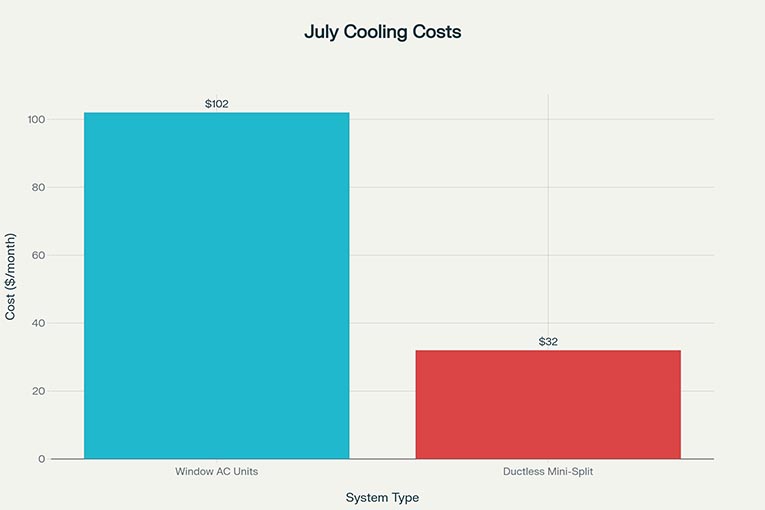
| Peak Summer Bill (July) | $102/month | $32/month | -68.6% |
| Runtime on 95°F Days | 10 hours/day (constant) | 4-5 hours/day | -50-55% runtime |
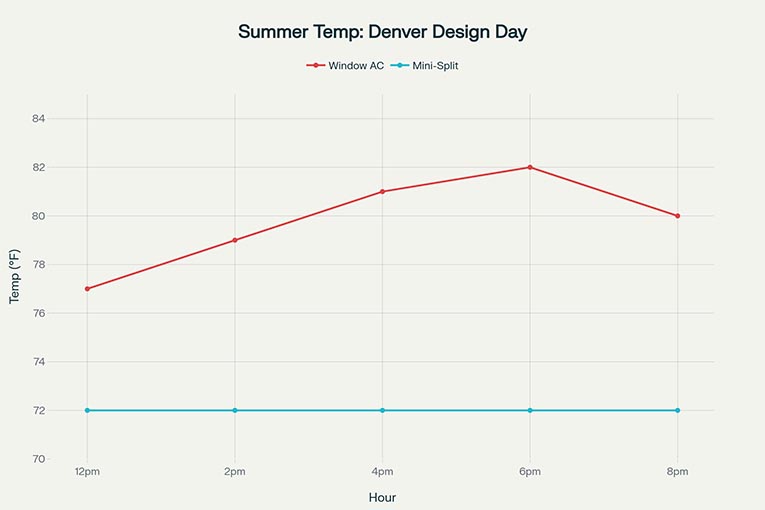
| Indoor Setpoint Temperature | 78-82°F (insufficient cooling) | 72°F (on design day) | -6-10°F, comfortable |
| Noise Level | 75-78 dB | 22-28 dB | -50 dB (imperceptible) |
July Electricity Cost for Cooling dropped from $102/month to $32/month:
Heating Performance:
| Metric | Furnace Only | Heat Pump + Furnace | Improvement |
|---|---|---|---|
| Backup Heat Events/Winter | 50+ @ $8-12 each | 2-3 @ minimal cost | -95% emergency heat |
| Shoulder Season Efficiency | 72% AFUE furnace | 2.8 COP heat pump | Furnace never needed Oct, Apr-May |
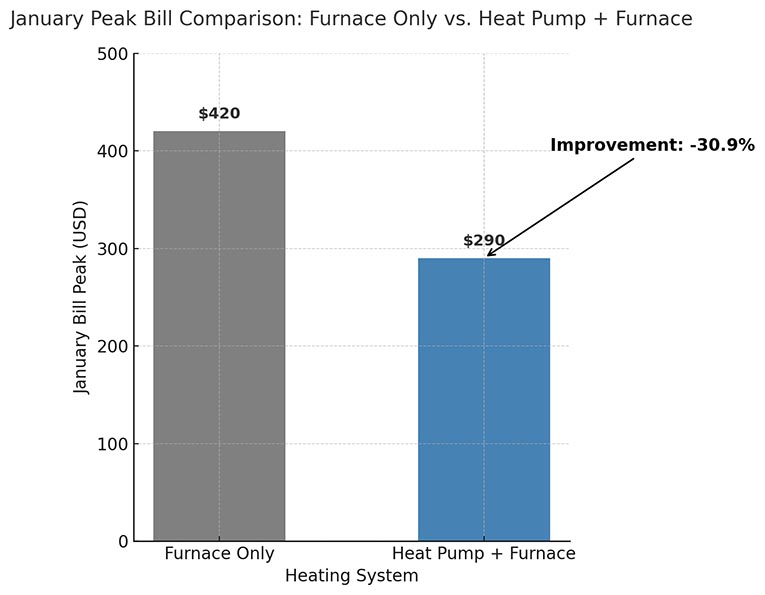
| January Bill Peak | $420 (furnace runs 18+ hrs/day) | $290 (heat pump covers 90%) | -30.9% |
| Comfort (Morning 6 AM) | 64-66°F (cold start) | 70°F (pre-heated overnight) | +4-6°F morning warmth |
The following chart highlights a 30.9% cost reduction with the heat pump solution. It provides a clear visual comparison for Denver’s Highlands homeowners who love energy-efficient upgrades.
Annual Energy Cost Summary:
- Pre-Retrofit Annual Cooling: 2,920 kWh × $0.105 = $307/year (3 window units, 120 days)
- Pre-Retrofit Annual Heating: 12,800 kWh furnace + 2,100 kWh backup electric = $1,580/year
- Pre-Retrofit Total: $1,887/year
- Post-Retrofit Annual Cooling: 960 kWh × $0.105 = $101/year (mini-split, same 120 days)
- Post-Retrofit Annual Heating: 8,400 kWh furnace + 800 kWh heat pump electric = $1,050/year
- Post-Retrofit Total: $1,151/year
- Annual Savings: $1,887 – $1,151 = $736/year
- Equipment Cost: $8,500 (outdoor unit, three indoor heads, refrigerant, installation labor)
- Simple Payback: 8,500 / 736 = 11.6 years
Comfort & Lifestyle Impact
Quantified Improvements:
- Summer Comfort: Indoor temperature maintained within ±1.5°F of setpoint (vs. ±5-8°F with window units). Remote work meetings no longer disrupted by AC noise.
- Winter Comfort: Heat pump pre-heating during shoulder season eliminated need to manually boost furnace; mornings now 70°F instead of 64-66°F.
- Humidity Control: Mini-split provides superior dehumidification (latent cooling capacity); Denver’s dry climate combined with heat pump moisture removal keeps indoor humidity 35-45% (vs. 50-55% with minimal window AC latent control).
- Noise Reduction: Weekend mornings no longer disrupted by AC units. Remote work audio quality improved—no background AC noise on video calls.
Operational Benefits:
- Smartphone Control: Residents can cool home before arrival (e.g., cool to 72°F by 5:00 PM while away); heating engaged remotely if unexpected cold snap occurs
- Occupancy Optimization: Two occupants can maintain different zone temperatures simultaneously (one zone 72°F office, another zone 76°F guest room if unused)
- Maintenance: Cleanable filters vs. window unit condensers; easier upkeep for modern equipment
High-Altitude HVAC Considerations
Denver-Specific Optimization:
- Refrigerant Line Sizing: Standard residential mini-split uses 1/4″ suction line for 25 feet; this system used 3/8″ suction for 80-foot run to minimize pressure drop at 5,280 ft (lower air density = lower refrigerant pressure, need larger diameter to avoid excessive friction loss).
- Charge Weight: Mitsubishi spec sheet provided Denver elevation correction factor of 0.968 (3.2% reduction); calculated final charge 4.2 lbs (vs. sea-level 4.35 lbs).
- Heating COP Advantage: Denver’s moderate winter (16°F average January, not extreme -10°F constant) means heat pump operates efficiently 90% of heating season; furnace backup minimal. Contrast to Minnesota where heat pump inefficiency at -20°F would require furnace constantly.
- Dry Climate Benefit: Lower latent cooling load than humid regions; mini-split dehumidification capacity well-matched to demand.
Maintenance Protocol for Homeowner
Monthly:
- Check outdoor unit for debris (clear any leaves, pollen accumulation)
- Visually inspect indoor unit filters (if dusty, schedule cleaning)
Quarterly (Every 3 Months):
- Clean indoor unit filters (either rinse or replace, depending on dust level)
- Check condensate drain line for blockage (run water through to verify flow)
- Review smartphone app energy consumption trends
Annually (Before Cooling Season – May):
- Professional service visit: refrigerant charge verification, electrical safety inspection
- Outdoor coil cleaning (Denver’s higher altitude + particulate matter warrants annual cleaning)
- Compressor oil analysis (check for moisture/copper contamination indicating refrigerant leak risk)
Every 5 Years:
- Full system performance test (cooling/heating capacity verification)
- Condenser fan blade replacement (preventative wear item)
Client Long-Term Outlook & Satisfaction
The Highlands homeowners report significant advances in comfort, noise, and efficiency. With the ductless mini-split, summer indoor temperatures now consistently stay within ±1.5°F of the 72°F setpoint, compared to the previous ±5-8°F drift common with window units. Remote work and sleep have both improved: office video calls and evenings are free of AC background noise (22-28 dB for the new system versus 75-78 dB before).
During the winter shoulder season, the mini-split system’s variable-speed heat pumps pre-heat the main areas, while the older furnace serves as backup. Winter mornings are now 70°F even after overnight setbacks, a marked improvement over the prior 64-66°F. Annual utility cost reductions ($736 per year based on real pre/post billing) deliver an 11.6-year simple payback at 2024 utility rates.
Humidity control and air quality are also improved: the mini-split maintains indoor RH in the 35-45% range without condensation or musty air. The smartphone-powered zoning allows efficient heating/cooling only for occupied rooms, and automated schedules further cut waste.
It’s also important to point out that the system did not require any invasive ductwork or aesthetic compromise, and this is crucial for Denver’s historic housing stock.
As a result, the real estate analysis indicates an expected boost of $8,000-$12,000 in resale value due to the whole-home comfort upgrade. The maintenance necessities are lower, while the home’s comfort and energy profile is future-ready, particularly if insulation or window upgrades are done in the coming years.